The Appprentices
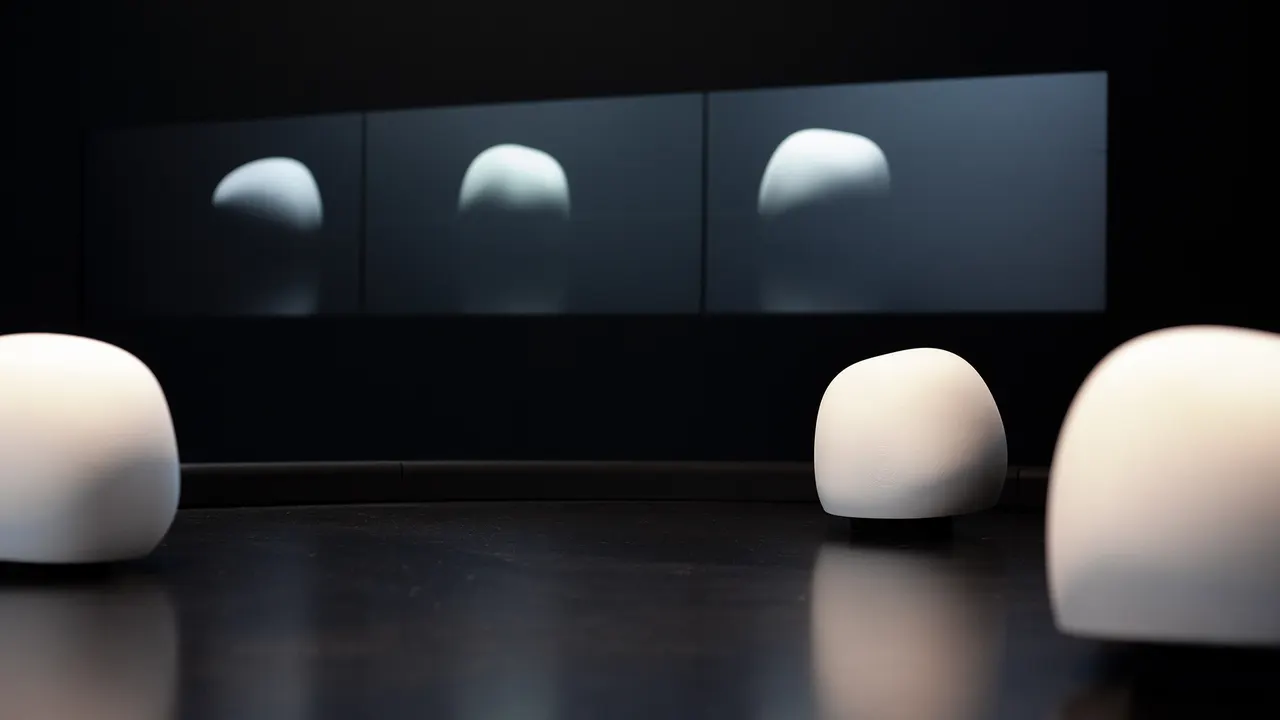
EnsadLab & Orange · 2022 · C++, robotique — des robots apprenants exposés à la Biennale de Saint-Étienne.
- Client
- Samuel Bianchini
- Venue
- Salon du design, Saint-Étienne
Tech stack
Behavioural objects in interaction.
1. Experimental research — Les Appprenants is a design research project carried out by multidisciplinary teams from Orange Innovation and EnsadLab (the laboratory of École des Arts Décoratifs, Paris). Following an experimental approach that brings together the human sciences — anthropology and cognitive science in particular — robotics and computer science (machine learning) with digital creation and innovation, the project explores new modes of relation between people and environments made robotic and augmented by artificial intelligence.
If our everyday objects can be granted the faculties of movement and learning, of action and reaction — a behavioural dimension — how are we to conceive new relations with these robotic artefacts, and between them? An instrumental apparatus was built to experiment with such “behavioural objects”, wagering on an original way of binding movement and sound tightly together: vibration, the vibratory space as a system of communication and interaction.
2. An instrumental apparatus — On the surface of a wide circular plinth, three objects of the same abstract, mineral-looking form move irregularly, as if animated by a will of their own and, at the same time, by a desire for relation, even for synchronisation, with their fellows. They are behavioural objects that compose different scenarios together, seeking to learn from one another through a program based on machine learning.
Their movements appear all the more rhythmic for being sounded: rooted in the materiality of the objects — their motors as much as the noise of their travel — these sounds are transformed and amplified by the vibratory space of the plinth, generating an almost musical sound environment meant to be shared by the objects and the audience alike.
The apparatus as a whole is henceforth to be considered an instrument. The movements and rhythms of the objects play out autonomously at first, but the rim of the stage also offers a percussion surface: breaking with the autonomy of the system, the audience is invited to interact with the objects by producing vibrations with their fingers on the edge of the plinth.
For exhibition, the piece can be approached either through a video carrying the sound of the real objects amplified by the plinth, or during dedicated demonstration sessions in which it is also possible to interact with the robotic objects. 3. A design of agency — In an age of increasing robotisation, and of the necessary recognition of the agency of non-human actors, Les Appprenants offers the experience of behavioural objects and the shared perception of their “animacy” — intentionality and personality — through original modes of relation, within a vibratory space.
Following a multidisciplinary, instrumental approach to research and creation, the project brings out methods and tools for building the field of “agency design”, which questions our sensory relations to digital and physical environments. Credits. A project devised by Samuel Bianchini, Elena Tosi Brandi and Hugo Scurto with the collaboration of Franck Weens, Corentin Loubet and Jeffrey Becker, as part of a research partnership between Orange’s Art Direction Nods team (Xdlab) and the Reflective Interaction research group at EnsadLab, the research laboratory of the École nationale supérieure des Arts Décoratifs (Université Paris Sciences et Lettres).
Interaction design: Samuel Bianchini, Elena Tosi Brandi and Hugo Scurto. Object design: Elena Tosi Brandi and Corentin Loubet. Sound design: Hugo Scurto and Victor Audouze. Machine-learning software development: Franck Weens with Hugo Scurto. Robotics engineering: Colin Bouvry. Video: Frédéric Mit with Anastasiia Champeau. Scenography build: Kilian Connan with Alexandre Kouklia.
With thanks to Olivier Bienz, Didier Bouchon, Édith Buser, Sarah Chazalette, Camille Dauhut, Pierre-Yves Dougnac, Jean-François Dubernard, Serge Foutrier-Bielakoff, Jules Françoise, Jean-Philippe Lambert, Annie Leuridan, Emmanuel Mahé, Joséphine Mas, Marc Milelli, Jean-Philippe Millerat, Chantal Maugin, Christophe Pornay, Emmanuel Tibloux, Thomas Trayssac, Adèle Roy and Lucile Vareilles.
The scenography elements were made at La Grange, a temporary occupation site run by Plateau Urbain. The objects were produced with the help of Sculpteo.